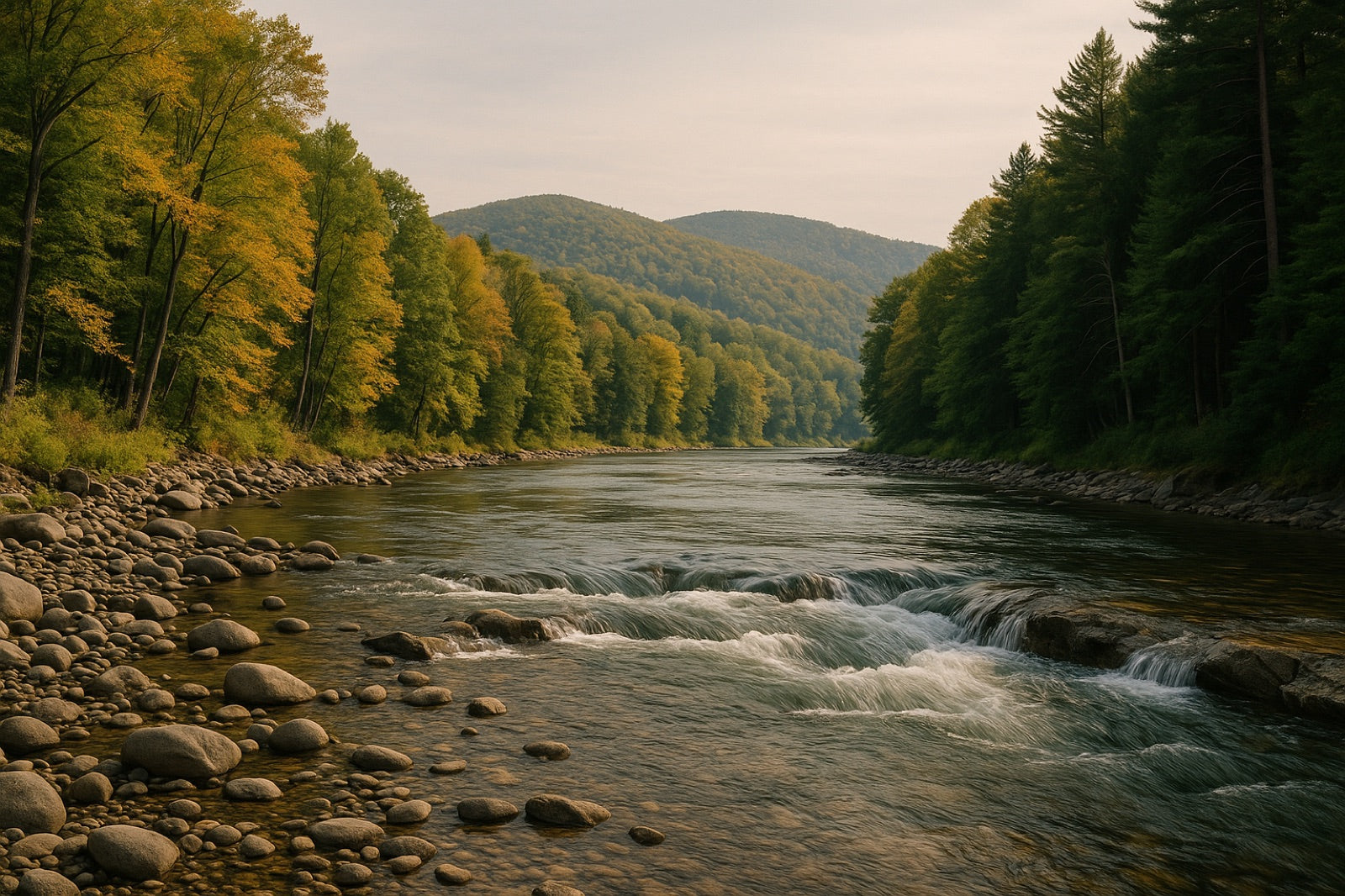
The White River

Vermont · Wild & stocked freestone

The White River

Vermont's longest free-flowing river — a classic freestone that rewards a searching dry and covering water.

The White runs undammed from the spine of the Green Mountains to the Connecticut, a long, braided freestone of riffles, runs, and pocket water. Wild and stocked browns and rainbows hold throughout, with wild brookies in the cold upper branches. It's a river for reading water and searching — cover ground, fish the seams, and let a buoyant dry do the work.

Shop the White River box →

The water

About The White River

The White runs undammed from the spine of the Green Mountains to the Connecticut, a long, braided freestone of riffles, runs, and pocket water. Wild and stocked browns and rainbows hold throughout, with wild brookies in the cold upper branches. It's a river for reading water and searching — cover ground, fish the seams, and let a buoyant dry do the work.

Wild and stocked browns and rainbows through the main stem; wild brook trout in the cold upper branches. General Vermont trout regulations apply on most of the main stem; a Vermont license is required. Some branches carry special or catch-and-release rules — confirm current Vermont Fish & Wildlife regulations.

As a freestone river it lives and dies by the weather — high and cold with spring runoff, low and warm by late summer, and at its best in the cool shoulder seasons. 9 ft to 4X–5X for searching dries and dry-droppers; the freestone forgives a slightly heavier tippet than a spring creek. Catch-and-release where you can; barbless, wet hands, quick release, and mind summer water temps.

Regulations & Stamp

General Vermont trout regulations apply on most of the main stem; a Vermont license is required. Some branches carry special or catch-and-release rules — confirm current Vermont Fish & Wildlife regulations.

Rochester to the Connecticut

The White River — Rochester to the Connecticut.

Fishing spots — compiled from guide reports & r/flyfishing (some locations approximate)

  1. RochesterThe narrow, clear upper river through farmland along VT 100 — brookies and rainbows, best in spring. Compiled from guide reports & r/flyfishing.Get directions
  2. StockbridgeThe middle river's wider riffles and pools along Route 107 — the best wade fishing. Compiled from guide reports & r/flyfishing.Get directions
  3. Artificial-Only SectionThe 3.3-mile artificial-flies-only stretch — wild rainbows in the 10-14 inch range. Location approximate. Compiled from guide reports & r/flyfishing.Get directions
  4. GaysvilleA well-known reach between Stockbridge and Bethel — deep pools and pockets. Location approximate. Compiled from guide reports & r/flyfishing.Get directions
  5. Bethel (FFO)The fly-fishing-only water from Cleveland Brook to Linnieville Brook. Compiled from guide reports & r/flyfishing.Get directions
  6. RoyaltonDeeper, slower pools downstream — trout and smallmouth, good float water. Compiled from guide reports & r/flyfishing.Get directions

This week on the water

River Report

The current read on the water, with live flow and water temperature from the USGS gauge that frames the fishery, over the historical range for the date.

River Report

September 25, 2026

White River is fishing well for September — flows are near normal and the bugs are on schedule.

White River is reading about 167 cfs at the West Hartford, VT gauge this week — within the typical range for the date. That's about as good as the reading gets for the date — the fish are where they should be and willing to move for a well-presented fly. As a freestone river it lives and dies by rain and snowmelt — cold and pushy in spring, lower and warmer by late summer.

September on the water: Fall turn — Isonychia, returning BWOs, and streamers move the big browns. Right now that means Isonychia, BWO, Woolly Bugger, and Parachute Adams — carry a couple of sizes of each and let what's actually on the water pick the fly.

The read: It's a good week to be out — mornings and evenings will fish best as the light comes off the water. Water temperature matters more than the calendar in September — if it climbs into the high 60s, give the trout a rest and come back when it cools. Always confirm the current Vermont Fish & Wildlife regulations before you go.

Compiled from the USGS gauge at West Hartford, VT and regional hatch timing — a read on the water, not a substitute for your own eyes on it.

Conditions & Access

Loading flow…

Loading the last 30 days of flow…

The box for this water

The White River Box

The proven patterns for the White River, curated into one box — the confidence flies and the ones that match this water's hatches, hand-tied and ready to fish in a Day Tripper fly box. Buy the box and save versus picking them one at a time.

$65.45$71.147 patterns · in a Day Tripper fly box

Save $5.69 vs. buying à la carte

Curated for the White River. Hand-tied flies, shipped direct.

What's in the box

  • Parachute AdamsSize 14 · 3-packThe everywhere mayfly dry.
  • Elk Hair CaddisSize 14 · 3-packThe searching summer dry — riffles and pocket water.
  • Foam BeetleSize 14 · 3-packA terrestrial for tight-to-the-bank fish in the heat.
  • Pheasant TailSize 10 · 3-packThe year-round confidence nymph.
  • Prince NymphSize 16 · 3-packA flashy attractor nymph for faster water.
  • Woolly BuggerSize 4 · 3-packThe streamer that moves fish when the dries die.
  • Hare's EarSize 16 · 3-packThe buggy all-purpose searching nymph.
  • Day Tripper Trout Fly Box The box Your flies arrive ready to fish, in a real fly box.

Season & hatches

The White River, month by month

A month-by-month hatch calendar for this water — the bugs that matter and the flies that match them. Sizes are typical ranges; go smaller in clear, low water.

Month What's hatching / conditions Go-to flies
January Cold and slow; a few midges on the mildest afternoons. A deep-nymph month. Midge, Perdigon, Pheasant Tail
February Still winter; midges and the first tiny black stoneflies when it warms. Midge, small stonefly, Zebra Midge
March Ice-out and rising water; early Blue-Winged Olives and little black stones on grey days. BWO, small stonefly, Hare's Ear, Pheasant Tail
April Spring comes alive — Quill Gordons, Hendricksons, and the first caddis. Hendrickson, Quill Gordon, Elk Hair Caddis, BWO
May Prime time: Hendricksons, March Browns, Grey Fox, and heavy caddis. March Brown, Grey Fox, Elk Hair Caddis, Hare's Ear
June Sulphurs, Isonychia, and evening caddis; terrestrials begin. Sulphur, Isonychia, Elk Hair Caddis, Foam Beetle
July Summer settles in — Tricos at dawn, caddis, and terrestrials all day. Trico, Elk Hair Caddis, Ant, Foam Beetle
August Low, clear, and technical — Tricos mornings, terrestrials midday, Isonychia into dark. Trico, Foam Beetle, Ant, Isonychia
September This month Fall turn — Isonychia, returning BWOs, and streamers move the big browns. Isonychia, BWO, Woolly Bugger, Parachute Adams
October Blue-Winged Olives on grey days and streamers for aggressive fall fish. BWO, Woolly Bugger, Pheasant Tail, Zebra Midge
November Cold and clearing; midges, BWOs, and streamers through the spawn. BWO, Midge, Woolly Bugger, Perdigon
December Deep-winter nymphing; midges on the mildest afternoons. Midge, Perdigon, Pheasant Tail, Zebra Midge

Hatch timing shifts with the season and the weather — watch the water, not the calendar. Compiled from regional hatch data and local reports.

Know the fishery

  • Wild or stocked

    Wild and stocked browns and rainbows through the main stem; wild brook trout in the cold upper branches.

  • The rig

    9 ft to 4X–5X for searching dries and dry-droppers; the freestone forgives a slightly heavier tippet than a spring creek.

  • Release

    Catch-and-release where you can; barbless, wet hands, quick release, and mind summer water temps.

The flies

Flies That Fish Here

The flies we'd carry for the Battenkill right now — one pattern per card, pick your hook size.